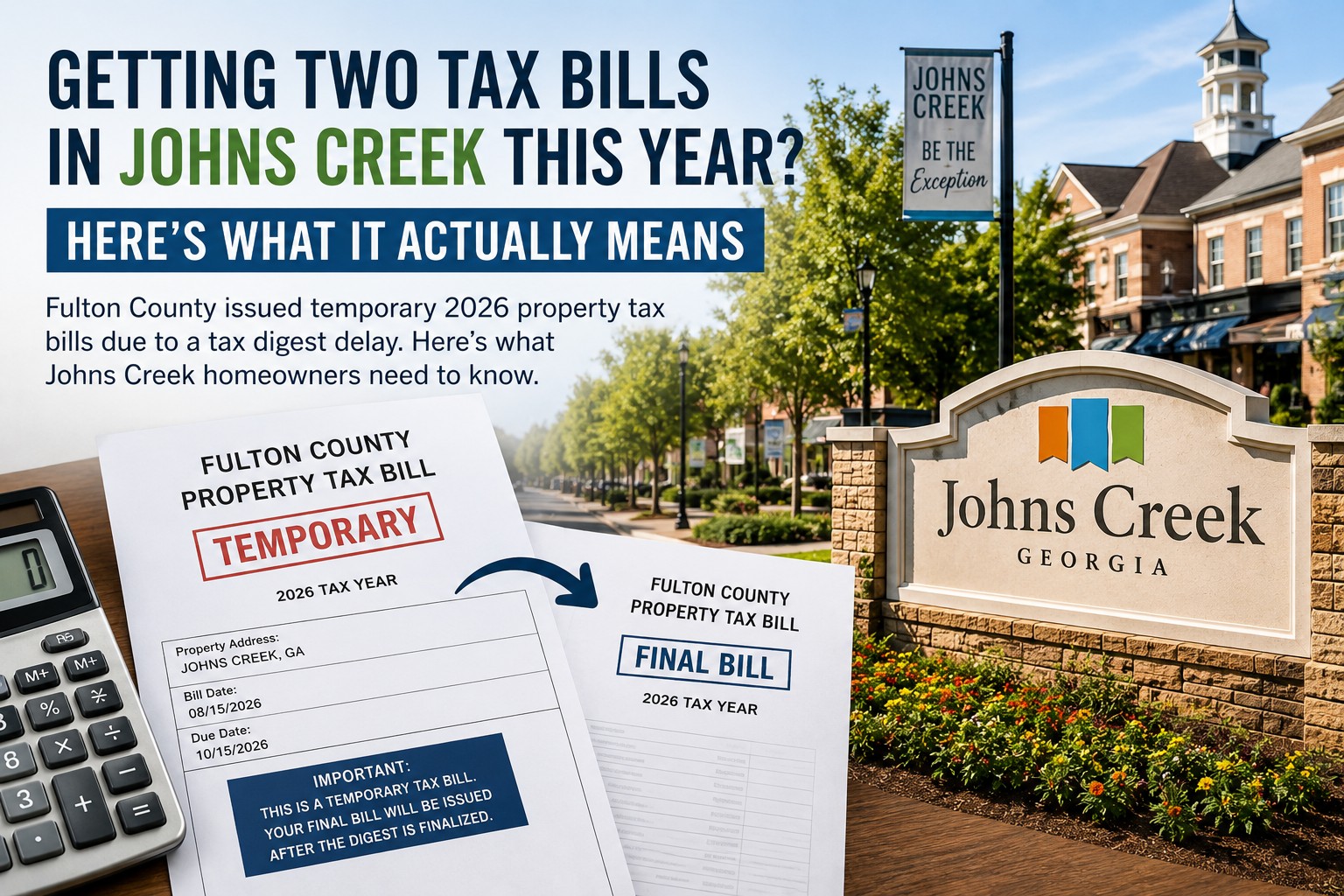
If more than one bill arrived in your mailbox this tax season, please take a breath, you have not done anything wrong, and you are not being double-charged for the same thing. The most common reason a Johns Creek homeowner sees two bills around the same time is simple: your property taxes and the city's stormwater utility fee come on separate bills, from two different government bodies. Here is what each one is, why both are legitimate, and what it really costs to own a home in Johns Creek.
The Short Version
Think of the two bills as two separate obligations doing two different jobs. Bill number one is your property tax, which is billed and collected through Fulton County on behalf of the county, the Fulton County school system, and the City of Johns Creek. Bill number two is your city stormwater utility fee, a separate charge from the City of Johns Creek that funds its stormwater management program. They are not the same service, they are not a duplicate, and they are not a mistake. It is simply how a homeowner in Fulton County, incorporated within the City of Johns Creek, is billed. Let me walk you through each one so it all makes sense.
Bill #1: Your Property Tax Bill (Fulton County)
Your main property tax bill still comes from Fulton County, because property taxes in Johns Creek are assessed and collected through the county. Even though Johns Creek is its own city, it sits within Fulton County, so the county handles the billing for everyone within its borders.
That one Fulton County tax bill covers three pieces of your total levy: Fulton County government, the Fulton County school system, and the City of Johns Creek. It is one consolidated bill from the county, even though several local governments benefit from it. You pay on the assessed value of your property, and the bill tells you how much of each rate went where. When you pay it, you are paying the county, and the county distributes the appropriate portion to the city and schools.
Bill #2: Your Stormwater Utility Fee (City of Johns Creek)
Now for the second bill, and this is the one that surprises most people. The City of Johns Creek established its Stormwater Utility under Ordinance 2021-06-18, effective June 21, 2021, to fund the city's stormwater management program: the pipes, drains, catch basins, detention ponds, and water-quality work that keep rain running off your streets and properties safely.
This stormwater bill is a user fee, not a tax. That distinction matters. It is not based on the value of your home the way a property tax is. Instead, the fee is based on how much runoff your property contributes, measured by the amount of impervious surface you have, think driveways, rooftops, pavement, and patios. A property with a lot of hardscape pays a higher fee than one with large lawns and natural ground, because it puts more stormwater into the city's system.
In practice it is a modest charge. For most homes it works out to roughly a few dollars a month, up to around $15 depending on your lot and how much impervious surface you have. It is billed separately by the city, on its own schedule, which is exactly why a homeowner can find it landing in their mailbox around the same time as the Fulton County tax bill, and wonder what is going on. You can pay it through the city at johnscreekga.gov/stormwater.
Wait, Is This a Double Charge?
No, and this is the reassurance I want to give you clearly. These are two different obligations to two different government bodies, and both are legitimate. One is your property tax, which funds county, school, and city services based on your property value. The other is your city stormwater utility fee, which funds a specific drainage and water-quality system based on how much rainwater your property sends into it. Different services, different calculations, different billing. Neither is a mistake, and neither is the same charge being billed twice.
A quick note on the bigger picture: Georgia has made recent changes that can also affect what appears on your tax bill from year to year. HB 581, the Save Our Homes Act, introduced a floating homestead exemption effective January 2025, and the HOME Act (SB 33, signed in May 2026) changed how homesteaded property value increases are capped at inflation. I am not giving tax or legal advice here, but if your bill looks different from a previous year, it is worth checking your assessment and confirming your exemptions are applied. A few quiet minutes reviewing those can clear up a lot of confusion.
Good News for Johns Creek
Here is the part that should put your mind at ease. For all the paperwork, Johns Creek remains a relatively tax-efficient place to own a home. The city has kept its property tax millage among the lowest in North Fulton, and in 2025 it approved a rollback rate, the property tax rate that brings in the same revenue as the year before, which resulted in the lowest levy in at least a decade. Effective property tax rates in Johns Creek have also tended to come in below state and national medians.
I want to keep these numbers general and approximate, because the point here is the trend, not a single figure: Johns Creek has historically been a place where you get top-tier schools, low crime, and a celebrated quality of life without carrying one of the heaviest tax loads in the region. When I help buyers weigh the true cost of living here, that combination of amenities and relatively modest taxes is consistently part of the appeal.
My Take, After 23 Years in North Fulton
Johns Creek is one of my core service areas, and I have watched this city grow through more than two decades of market cycles. I understand that the true cost of ownership is more than the purchase price; it includes taxes, fees, upkeep, and the day-to-day reality of living somewhere. That is exactly why I like to walk clients through the numbers up front, so there are no surprises later.
This post is meant to be educational, not tax or legal advice. Every situation is a little different, so it always pays to check your own assessment and exemptions. But if the picture is fuzzy and you want a clear, honest read on what it really costs to live in Johns Creek, I would genuinely love to help.
Buying or selling in Johns Creek? Understanding the true cost of ownership is part of my job. Let's talk about what it really costs to live here, or book a complimentary consultation on my calendar.
Looking forward to helping you,
Julia